
Getting your window measurements right is the most critical step in any replacement project. It involves taking precise height, width, and depth measurements of the window opening to ensure your new unit is a perfect match. A tiny error here can snowball into costly mistakes, annoying drafts, and major installation headaches later on.
Why Precise Measurements Are Your First Step
For homeowners in Monterey County, getting window measurements right from the start is about more than just aesthetics. A perfect fit is your first line of defense against our unique coastal climate, helping you manage energy costs and protect your home. A small miscalculation can lead to frustrating drafts, water leaks, and surprisingly high energy bills.
As a local, family-operated business serving Salinas, Monterey, and Carmel, we've seen how accurate numbers prevent expensive problems. This guide is built on our decades of experience to help you achieve a flawless result. Taking the time to be meticulous now ensures your new windows perform exactly as they should for years to come.
Key Takeaway: A window that's even a quarter-inch too big just won't fit. But a window that’s slightly too small can be professionally shimmed and sealed by an expert for a perfect, weather-tight installation. Precision is everything.
The Foundation of a Successful Project
Think of your measurements as the foundation for your entire window replacement. If the foundation is off, everything you build on top of it will be compromised. Here’s why getting this initial step right is so critical for homeowners in Salinas:
- Prevents Ordering Errors: Custom-ordered windows are non-refundable. Measuring correctly means you order the right size the first time, avoiding wasted money and project delays.
- Ensures Energy Efficiency: A window’s energy-saving power hinges on a tight seal. Gaps from poor measurements let air seep in and out, defeating the purpose of installing new, energy-efficient windows.
- Guarantees Proper Operation: A window forced into a crooked or improperly sized opening might not open, close, or lock correctly, creating daily annoyances and serious security issues.
According to industry data, the global residential window market was valued at around USD 103 billion in 2022 and is projected to keep expanding as homeowners invest in energy efficiency. This trend shows how much homeowners value getting the fundamentals right—and that starts with proper measurements. For a detailed look into the replacement process, check out our guide on home window replacement in Salinas.
Gathering the Right Tools for the Job
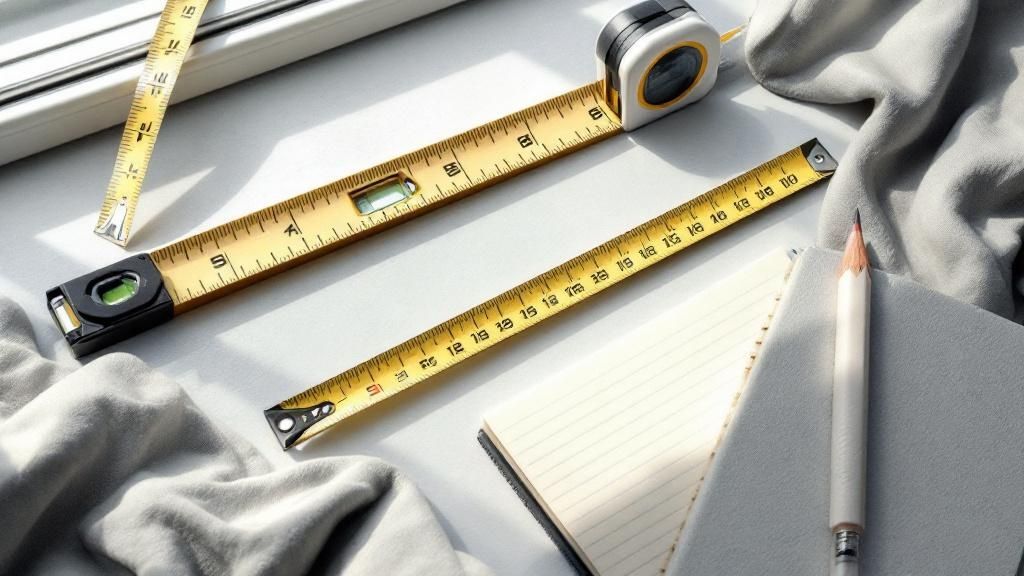
Before you take that first measurement, let's talk about tools. Any experienced installer in Monterey County will tell you that accuracy starts with having the right equipment on hand. It’s a simple step that makes the entire process smoother and far more reliable.
You don't need a full workshop. Just a few key items will ensure the numbers you record are the numbers you actually need for a perfect-fitting window. For homeowners from Salinas to Carmel, a little preparation truly goes a long way.
Your Essential Window Measuring Toolkit
To ensure your measurements are precise and reliable, you'll need a few key items. Gathering these now will save you from frustrating interruptions later.
| Tool | Why You Need It | Pro Tip |
|---|---|---|
| A High-Quality Steel Tape Measure | This is your most important tool. A flimsy or old tape can stretch or sag, leading to bad readings. A 25-foot steel tape is ideal. | Always use a steel tape measure. A cloth or vinyl one can stretch, which is the last thing you want when precision matters. |
| Pencil and Paper (or Digital Notepad) | Don't trust your memory. Write down every single measurement the moment you take it. A simple sketch of each window helps keep things organized. | We like to draw a quick box for each window and label the width and height right on the drawing. It prevents mixing up numbers later on. |
| A Sturdy Level | You’ll need this to check if your existing window frame is square. It’s a common issue in older Monterey County homes that can complicate installation. | Place the level on the sill and then check the jambs. If it's not perfectly level, make a note of it—your installer will need to know. |
| A Partner | Especially for larger windows, an extra set of hands is invaluable. They can hold the tape steady so it doesn't bend, ensuring an accurate reading. | A sagging tape measure can easily throw off your measurement by a quarter-inch or more. A partner guarantees a true, straight line every time. |
With these items assembled, you’re ready to approach this task with professional confidence. It’s a small investment of time that pays off big when your new windows slide into place flawlessly.
Pro Tip from Our Team: Always measure twice. It’s a simple habit that has saved countless homeowners in Salinas from costly ordering mistakes. Measure once, then measure again just to be sure before you write anything down.
How To Measure Your Window Opening Correctly
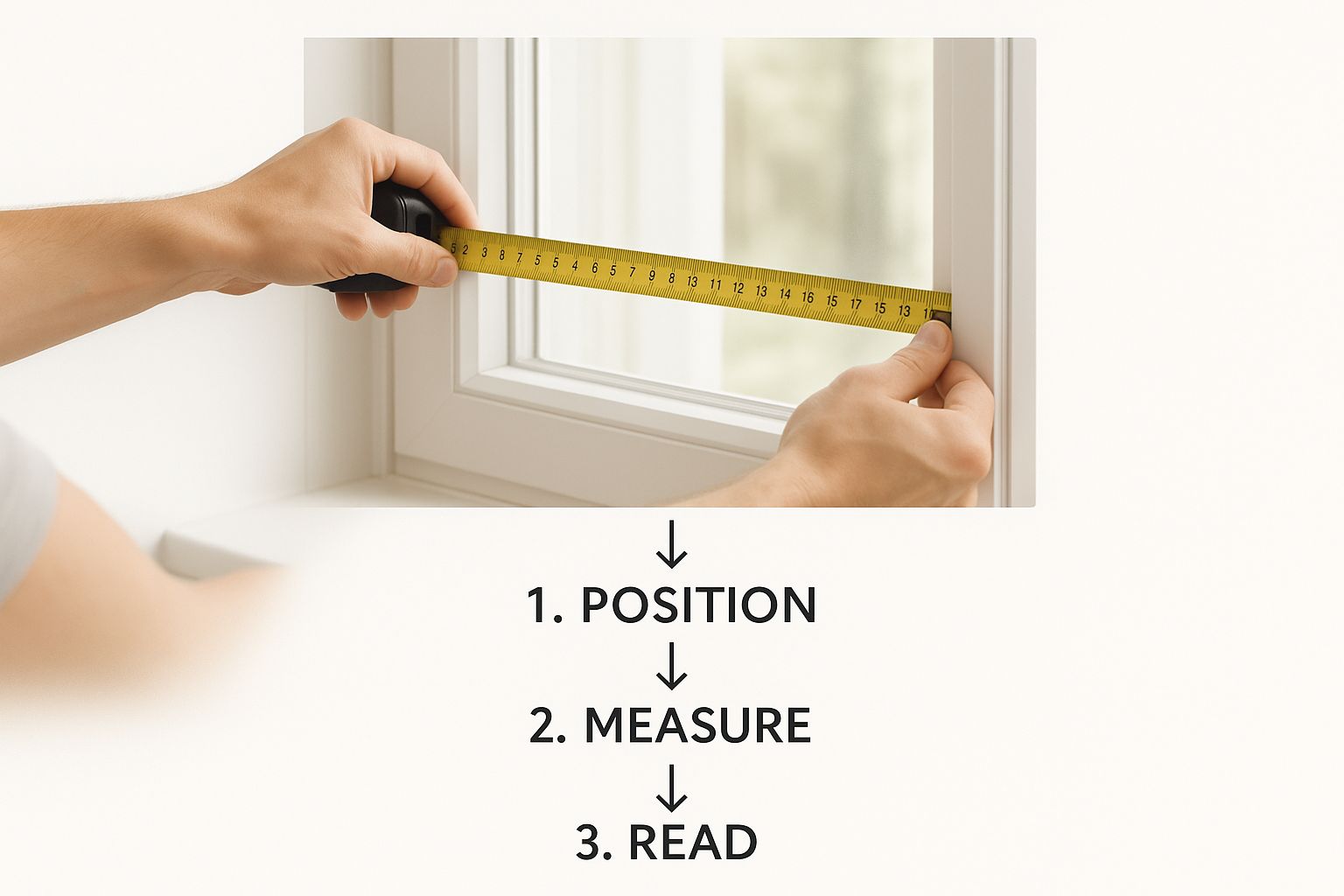
Now let's get to the most crucial part: getting the numbers right. Measuring windows for replacement isn’t a dark art, but it demands attention to detail. The techniques we use in homes across Salinas and Monterey are simple, but they’re designed to sidestep common mistakes.
Our goal here isn’t to measure your old window frame; we need to measure the rough opening—the actual space between the wall studs where your new window will be installed. Following a consistent method gives you the precise dimensions needed for a perfect, weather-tight fit.
Mastering The Width Measurement
First up, the width. From our experience, window openings are almost never perfectly square, especially in older Monterey County homes that have settled. That’s why you must take three different horizontal measurements to account for any variations.
Start by measuring the width from jamb to jamb across the top of the opening, then do it again across the middle, and finally, one last measurement across the bottom. Don't be surprised if these three numbers are slightly different; we see it all the time.
The Golden Rule of Measuring: Always use the smallest of your three measurements. If the top is 35 7/8", the middle is 36", and the bottom is 35 3/4", your official width is 35 3/4". Ordering a window based on that smallest dimension guarantees it will fit into the opening.
Capturing The Correct Height
You're going to use the exact same three-point technique for the height. This ensures you catch any inconsistencies in the frame's vertical alignment. You’ll be measuring from the head jamb (the top part of the frame) down to the sill (the very bottom where the window rests).
Take your three vertical measurements like this:
- Measure the height on the left side of the opening.
- Measure the height right down the center.
- Measure the height on the right side of the opening.
Once again, you’ll likely find slight differences. Write all three down, circle the smallest one, and use that as your final height. This is standard professional practice because it ensures your new window won't be too tall to install.
Don’t Forget The Jamb Depth
This is the measurement people forget most often, and it's absolutely critical. The jamb depth determines how deeply the new window will sit inside your wall, ensuring it lines up properly with both your interior and exterior siding. The wrong depth can leave you with awkward gaps or a window that juts out.
To get the jamb depth, measure the distance from the interior edge of the window stop to the exterior edge. On many windows, you might need to carefully remove a piece of interior trim to get an accurate reading from the full, flat surface of the jamb.
Checking if Your Window Frame Is Square
Once you have your height and width, there’s one last check that the pros never skip. Many homes, especially the beautiful, historic ones throughout Monterey and Carmel, have settled over the years. This movement can cause window frames to shift, meaning they are no longer perfectly square.
An out-of-square frame is a common issue that can seriously complicate a new window installation. If you try to force a new, perfectly square window into an opening that isn't, it can bind, leak, and refuse to operate correctly. Thankfully, checking for squareness is simple.
The Diagonal Measurement Trick
So, how do you know if your frame is square? You’ll measure it diagonally, from corner to corner. This simple test uncovers any hidden issues with the frame’s geometry.
Here’s how you do it:
- Extend your tape measure from the top-left corner of the opening down to the bottom-right corner. Jot this number down.
- Next, measure from the top-right corner down to the bottom-left corner. Write this second number down, too.
Now, compare the two measurements. If they're identical, your window frame is perfectly square! If the numbers are different, even by a quarter-inch, the frame is out-of-square.
What an Out-of-Square Frame Means for You
Discovering your frame isn't square isn't a reason to panic; it’s very common for homeowners in Salinas and the surrounding communities. However, it is a clear signal that it’s time to call in a professional installer.
An experienced window installation team knows exactly how to handle this. They’ll use shims and proven techniques to set the new window perfectly level and plumb inside the crooked opening, ensuring a flawless, weather-tight fit that will perform beautifully for decades.
This professional touch is more important than ever. According to some insights on the residential window market, homeowner demand for better insulation and stricter building codes continues to drive growth. Proper installation—in any frame, square or not—is fundamental to meeting these modern standards.
Common Measuring Mistakes to Avoid
Over our decades helping homeowners across Monterey County, we've seen a few common missteps completely derail an otherwise perfect window replacement project. Getting the measurements right is a game of precision. Even a tiny error can snowball into a big, expensive problem.
The good news? These pitfalls are entirely avoidable. Once you know what not to do, you can tackle your project with the confidence of a seasoned pro and skip the frustration of an ill-fitting window.
Forgetting to Measure the Opening Itself
One of the most frequent mistakes is measuring the old window pane instead of the actual frame opening. Your new window must fit snugly into the structural opening in the wall. If you just measure the visible glass or the existing sash, your dimensions will be too small.
Expert Tip: Always measure the rough opening. For the width, measure from the inside of one side jamb straight across to the other. For the height, measure from the head jamb at the top all the way down to the sill.
Taking Only a Single Measurement
Coming in a close second is taking just one measurement for width and one for height. Houses settle and shift over time, and what looks square to the eye is often slightly off. Relying on a single measurement ignores these critical variations.
As we covered earlier, you must take three separate measurements for both the width and the height:
- Width: Measure across the top, the middle, and the bottom.
- Height: Measure down the left side, the center, and the right side.
Always use the smallest of the three measurements for your final number. This simple step ensures the new unit will fit into the tightest point of the opening. Of course, getting measurements right is only half the battle; our guide on choosing replacement windows can help you select the perfect style for your home.
The Dangers of Rounding Your Numbers
In window replacement, every fraction of an inch is crucial. It can be tempting to round 35 7/8 inches up to 36 inches, but this is a critical mistake. An oversized window simply won’t fit, leading to costly reorders and frustrating project delays.
Always record your measurements with precision, down to the nearest 1/16th of an inch. The global market for energy-efficient windows is set to more than double to USD 34.6 billion by 2034, and that growth is fueled by advanced components that demand a perfect fit. You can discover more about the growing energy-efficient window market and see why this precision matters.
Assuming Identical Windows Are the Same Size
Never assume that two windows that look identical are the same size. Even in a newer Salinas home, slight variations during construction can mean the openings are different. This is even more common in the beautiful, older homes in Carmel or Pacific Grove.
Each window must be measured individually. Yes, it’s more work upfront, but it is the only way to guarantee every window you order is the correct size. This extra step will save you from a massive headache during installation.
When to Trust a Professional Installer
While taking your own measurements can work for a standard window replacement, some situations demand a professional's touch. Knowing when to call for help protects your investment and guarantees a perfect outcome. This is especially true for more complex projects.
When a Pro Is Your Best Bet
Think about installing large bay windows or custom-shaped arched windows. These require a level of precision that goes beyond a simple tape measure reading. The same goes for many of our beautiful historic homes around Monterey, which often have unique structural framing that presents unexpected challenges.
If a task feels even slightly daunting, it’s always best to consult with experienced professional window contractors. They have the tools and experience to ensure a flawless installation, avoiding costly mistakes and protecting your home.
Our Promise to You: For homeowners in Salinas, Monterey, and the surrounding communities, our team at Signature Glass and Windows provides free, no-obligation consultations. We are a local, family-operated business that guarantees a perfect fit for your home every time.
Don't let a tricky installation stand in the way of upgrading your home. For projects big or small, our dedicated team of Salinas window installers for home brings decades of local experience right to your doorstep. We take the guesswork out of measuring, providing the peace of mind that comes with impeccable results.
Frequently Asked Questions About Measuring Windows
Over the years, we've heard just about every question you can imagine from homeowners in Salinas and Monterey about measuring for new windows. To help you get started on the right foot, we've put together answers to the questions we hear most often.
What's the most important measurement to get right?
The smallest width and smallest height are the two numbers that matter most. Replacement windows are always ordered using these "tightest" measurements because a professional installer can easily shim and seal a window that's slightly smaller than the opening. A window that’s even a tiny bit too big just won't go in.
Should I be measuring the glass or the whole window frame?
You should always measure the window's rough opening, not the glass or the old window sash. For the width, measure from the inside of one side jamb to the other. For the height, go from the head jamb at the top all the way down to the sill at the bottom.
Does it really matter if my measurement is off by a quarter-inch?
Yes, it absolutely matters. An error of just a quarter-inch can create gaps that invite drafts and water leaks, compromising your home's energy efficiency and security. We work with precision down to 1/16th of an inch, and you should aim for that same level of accuracy.
My window frame isn't perfectly square. Can I still get a new window?
Yes, but this is exactly where a professional's touch is critical. Out-of-square openings are incredibly common in older homes around Monterey County. A skilled installer will use shims and other techniques to set your new, perfectly square window level and plumb within the crooked opening.
Do I have to measure every single window, even if they look the same?
Yes, without a doubt. Never assume that windows that look identical are the same size. We see it all the time—even windows right next to each other can have slightly different opening dimensions due to how the house has settled or small variations in the original construction. Measuring each one individually is the only way to be certain. These small differences are one of the many window installation budget and cost factors that can influence your project.
Ready to guarantee a perfect fit for your new windows? Trust the local experts at Signature Glass and Windows, Inc. to handle the measurements and installation with professional precision. As a family-operated business with decades of experience serving Salinas and Monterey County, we pride ourselves on quality craftsmanship and trustworthy service.
Contact Signature Glass and Windows today for a free in-home consultation at https://signatureglassandwindows.com or call us at 831-754-8855.