
When you hear about a “bad window installation,” it’s easy to picture a frame that’s just a little crooked. But the reality for homeowners in Salinas and Monterey is much more serious. A poor installation means the window wasn’t properly measured, sealed, or secured, leading to costly energy loss, uncomfortable drafts, and even long-term structural damage.
This critical failure can turn your investment into a major headache. Understanding the signs of a poor window installation is the first step in protecting your home and your wallet.
The Real Cost of a Bad Window Installation Job
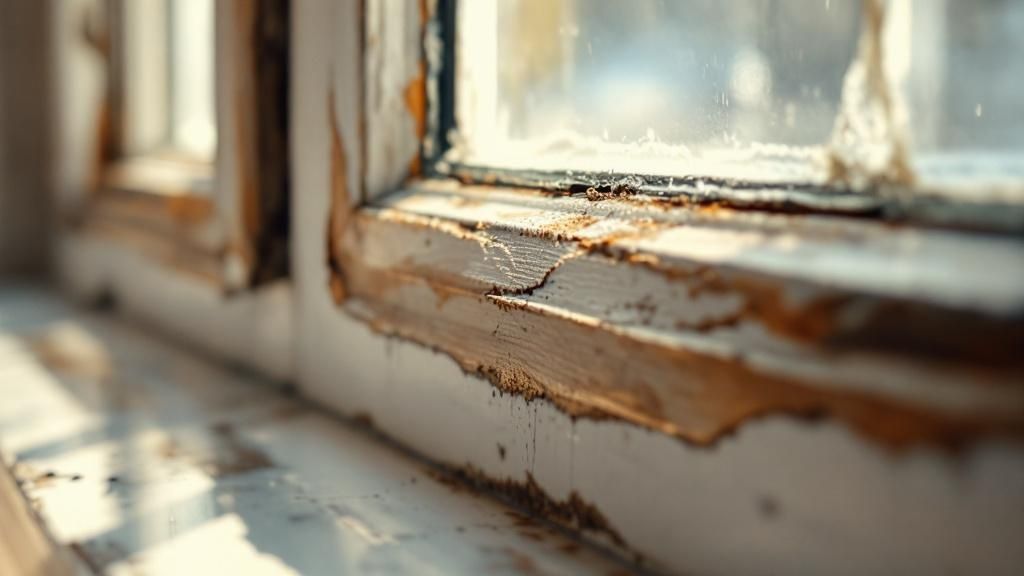
Putting new windows in your home should be an exciting upgrade. You’re looking forward to better views, a more comfortable living space, and hopefully, lower energy bills. But for homeowners here in Monterey County, the quality of the installation is every bit as important as the quality of the window itself.
A botched job can quickly turn that smart investment into a constant source of frustration and unexpected bills. Even seemingly small mistakes during the installation process can have huge consequences down the road.
Soaring Energy Bills
One of the first and most painful signs of a poor window installation is a sudden spike in your energy bills. According to the U.S. Department of Energy, windows can be responsible for up to 30% of your home’s heating and cooling energy use, and a bad installation job makes that number climb even higher.
When you have gaps and leaks from an improper seal, the conditioned air you’re paying for escapes outside. This forces your HVAC system to work overtime just to keep your home comfortable, costing you hundreds of extra dollars every single year.
Lasting Structural Damage
Beyond hitting your wallet every month, poorly installed windows can seriously threaten your home’s structure. When frames aren’t sealed correctly or the waterproof flashing is missing, rainwater has a direct route to get behind your walls. Over time, this moisture leads to a cascade of problems:
- Rotting wood in the window frame and the surrounding wall.
- Mold and mildew growth, which is a health hazard and expensive to get rid of.
- Damaged drywall and insulation, leading to more costly repairs.
A window installation isn’t just about sticking a piece of glass in an opening. It’s about creating a perfect, weatherproof seal that will protect your home from the elements for years. Skimping on this critical step is just asking for trouble.
To help you identify these issues before they become major problems, here’s a quick guide to some common red flags.
Quick Guide to Spotting Installation Red Flags
| Symptom You Notice | What It Likely Means for Your Home |
|---|---|
| Drafts or uneven temperatures near windows | Gaps in the sealant or a poorly fitted frame are letting outside air in. |
| Difficulty opening or closing the window | The window was not installed level and plumb, causing the sash to bind against the frame. |
| Condensation between the glass panes | The seal on the insulated glass unit (IGU) has failed, often due to stress from a poor fit. |
| Visible gaps around the frame, inside or out | The window was measured incorrectly or wasn’t properly shimmed and sealed in the opening. |
| Water stains on the wall or windowsill | A clear sign of water intrusion, likely from failed sealant or missing/improper flashing. |
| Cracks in the wall around the window | The house is settling around an improperly supported window frame, causing structural stress. |
| Increased outside noise | The seals are not airtight, which means they aren’t providing the sound insulation they should. |
If you notice any of these signs, it’s a good idea to have a professional take a look sooner rather than later. Much like you would analyze home security system costs before buying, you have to consider the long-term costs of a bad window job. This principle also applies to other glass products, which you can see in our guide to glass door installation costs.
How to Diagnose Installation Issues Yourself
You know that feeling—a persistent draft you can’t quite trace, or a brand-new window that just doesn’t feel right. The good news is, you don’t need a contractor’s toolkit to figure out what’s wrong. A few simple visual and functional checks are often all it takes to pinpoint the most common installation mistakes.
Catching these problems early can save you a world of headaches, especially for those of us in coastal communities like Carmel and Monterey. Here, a small installation flaw can quickly turn into a major issue due to constant exposure to wind and moisture.
Visual Checks for Obvious Flaws
Start with a simple visual inspection from both inside and outside your home. You’d be surprised how many installation mistakes are hiding in plain sight.
- Mind the Gaps: Look at the space where the window frame meets the wall. If you see large or uneven gaps, it’s a strong sign the window was either measured wrong or wasn’t properly centered in the opening.
- Inspect the Caulking: The caulk around your window’s exterior is its first line of defense. It should be a clean, continuous bead; if it’s cracked, peeling, or sloppy, the seal is compromised.
- Look for Condensation: Seeing moisture between the panes of a double-pane window is a major red flag. This means the airtight seal has failed, often because the unit was strained during an improper installation.
This image shows the basic steps for tackling air leaks, which are a classic symptom of a bad install.
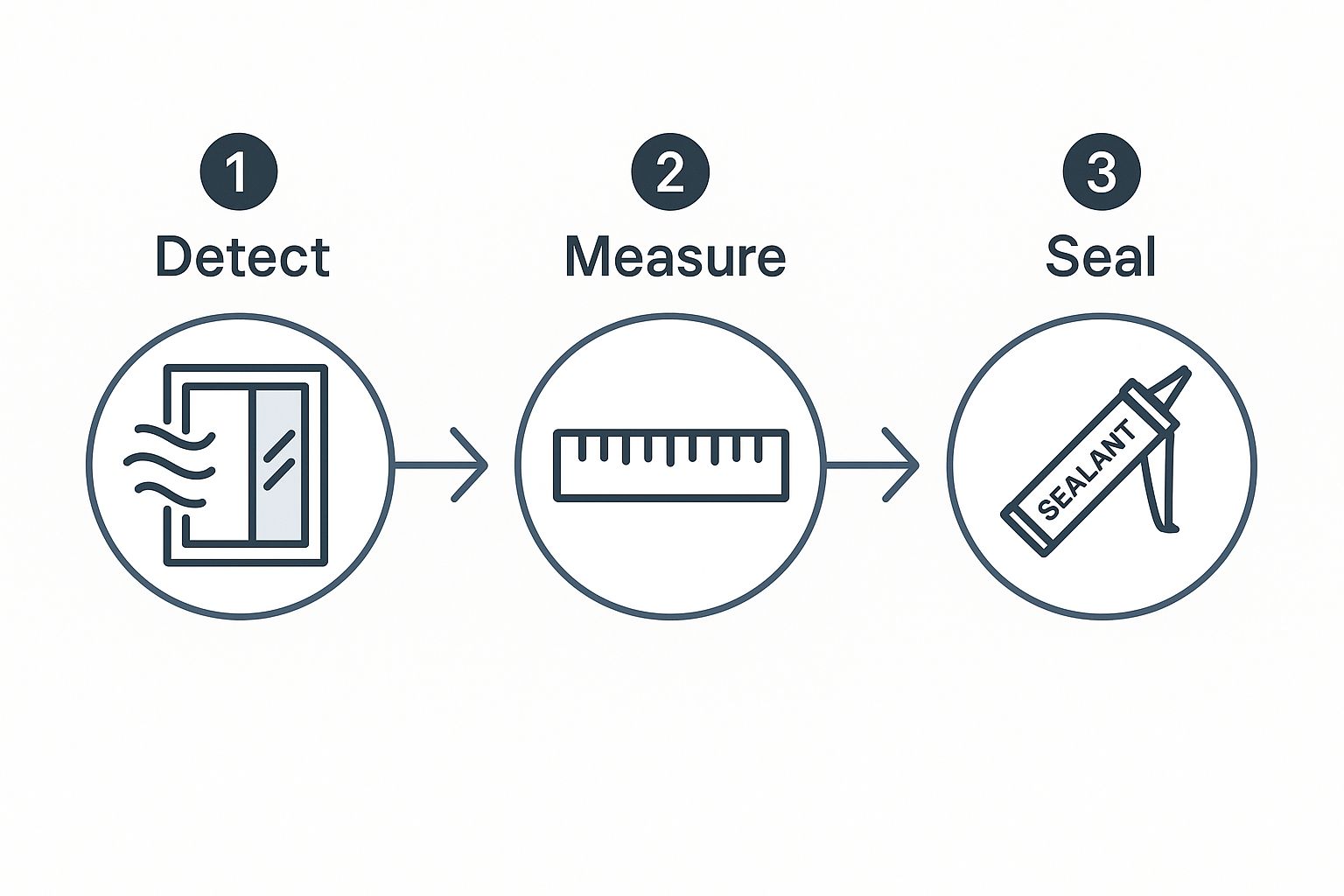
The key takeaway is that a real fix involves identifying the source of the draft, understanding the scope of the problem, and then applying the correct solution. A simple patch is rarely enough.
Functional Tests Anyone Can Do
Next, see how well your windows actually work. A properly installed window should operate smoothly and almost effortlessly.
Go around and test each window by opening and closing it a few times. If it sticks, scrapes, or requires force, it’s a classic symptom that the window was not installed plumb and level, causing the sash to bind against the frame.
Also, check the locks; they should click into place easily. If you have to jiggle the sash to get the lock to align, that’s another clear sign the window is out of square. These functional problems aren’t just annoying—they create real security risks.
A window that’s hard to open or lock isn’t just an inconvenience—it’s a symptom of a deeper installation problem. The frame is likely under stress, which can lead to seal failure, cracks, and further damage over time.
The consequences go far beyond a chilly breeze. As detailed by the International Association of Certified Home Inspectors, improper installation can lead to water intrusion, with repairs sometimes costing anywhere from $5,000 to $15,000 per incident. To get a better handle on the financial impact, it’s worth learning more about window installation defects and their costs.
Common Installation Mistakes and Why They Occur

When you find a problem with a brand-new window, figuring out why it happened is the first real step toward a proper solution. For homeowners in Salinas and Monterey, knowing the usual suspects helps you have a much more informed conversation with a contractor about fixing it the right way.
These mistakes often boil down to a few key issues, from installers cutting corners to save time to using cheap, subpar materials. Understanding what a proper installation involves helps you see exactly where yours went wrong.
Improper Sealing and Insulation
A window’s number one job is creating a solid barrier between your living space and the outdoors. A classic mistake is using low-quality caulk or applying it sloppily, leaving tiny gaps that welcome in drafts and moisture.
What’s even more critical is the stuff you can’t see. The gap between the window frame and the wall’s rough opening has to be meticulously insulated. The U.S. Department of Energy confirms that these air leaks are a huge source of energy loss in homes.
Failing to Set the Window Level and Plumb
This is one of the most fundamental rules of window installation, yet it’s shocking how often it’s ignored. A window must be perfectly level (side-to-side) and plumb (up-and-down). When it’s not, gravity and the house’s weight put constant, uneven stress on the frame.
A window that isn’t set perfectly square won’t just be difficult to open and close—it’s a ticking time bomb for seal failure. The constant, uneven pressure will eventually break the airtight seal between the glass panes, causing permanent fogging and eliminating any energy savings.
This is the root cause for windows that stick, are a pain to lock, or even cause cracks to appear in the surrounding drywall. We dive deeper into these specific symptoms in our guide to common window installation problems.
Missing or Incorrect Flashing
This mistake is the undisputed champion of causing serious water damage around windows. Flashing is a thin, waterproof material that is expertly woven around the window opening before the window goes in. Its sole purpose is to catch any water that gets behind your siding and direct it safely down and away from the wall.
When it’s missing or installed incorrectly, water gets trapped inside your walls, leading to a homeowner’s nightmare:
- Wood rot that can compromise your home’s structural integrity.
- Pervasive mold and mildew growing unseen inside your walls.
- Damaged insulation and ugly stains on your interior drywall.
This isn’t just a cosmetic problem; it’s a direct threat to your home’s health and value, especially in coastal areas like Carmel where wind-driven rain is common.
Your Options for Fixing a Poorly Installed Window
Finding out you have a poorly installed window is definitely frustrating, but you have clear options to make it right. For homeowners in Salinas and Monterey, the best path forward depends on how severe the problem is. Your goal should be a permanent solution, not just a quick patch.
A minor issue, like a small draft, might be fixable with a simple repair. But if you’re dealing with a window that’s a struggle to open or shows signs of water damage, that points to a much deeper failure.
When Is a Simple Repair Enough?
In some cases, you might not need to go through a full re-installation. A simple repair can be effective if the underlying installation was mostly correct but just has a minor flaw.
Here are a couple of scenarios where a repair might be all you need:
- Minor Drafts from Old Caulk: If the window is level and the exterior caulk has simply dried out, we can carefully remove the old sealant and apply a new bead of high-quality caulk.
- Weatherstripping Tune-Up: Sometimes the compressible seals, or weatherstripping, around a window get worn or dislodged. Replacing these components is a simple and effective repair.
However, these repairs only work if the window’s core installation is sound. Trying to patch a window that wasn’t installed level or flashed correctly is just a temporary band-aid on a bigger problem.
Deciding Between Repair and Full Re-Installation
The choice to repair or fully re-install usually comes down to one key question: is the problem with a component on the window, or with the way the window sits in the wall? If it’s the latter, a full re-installation is almost always the correct and most responsible choice.
A full re-installation involves carefully removing the window, diagnosing and fixing any damage to your home’s framing, properly flashing the opening to create a waterproof barrier, and then correctly setting and sealing the new window. This is the only way to permanently fix issues like water leaks, operational problems, or significant energy loss caused by a poor initial installation.
This might feel like a bigger investment upfront, but it’s a necessary one. In fact, industry data from IBISWorld shows that 15% of installation failures require rework within five years, with fixes costing over $2,000 on average. Choosing a proper re-installation from the get-go prevents you from paying for the same job twice and protects your home from future damage. If you’re comparing numbers, our guide on broken window repair costs can offer perspective.
Why Professional Installation Is a Smart Investment
Choosing new windows is a big decision, but who you hire to put them in is every bit as important. I’ve seen it time and again: a homeowner tries to save a few bucks with a handyman, only to face a fortune in repairs and voided warranties.
Investing in a qualified, experienced professional is the single best way to protect your home. It ensures those beautiful new windows perform exactly as they should for decades to come.
The Anatomy of a Quality Installation
A true professional doesn’t cut corners—period. Their process is thorough from start to finish, from protecting your home with drop cloths to a flawless cleanup. For homeowners in coastal communities like Monterey and Carmel, local expertise is non-negotiable.
So, what does a top-notch installation actually involve?
- Precise Measurements: Ensuring the new window is perfectly sized for the opening to prevent structural stress.
- Proper Flashing: Installing a waterproof barrier around the window to direct moisture away from your walls.
- Level and Plumb Setting: Guaranteeing the window is perfectly square so it opens, closes, and locks without a fight.
- Expert Sealing and Insulation: Using high-quality caulk and insulation to create an airtight seal for maximum energy efficiency.
This commitment to doing things the right way is what separates a trustworthy installer from a risky gamble. A good contractor hiring checklist can be an invaluable tool to make sure you’re asking the right questions.
Choosing a professional isn’t an expense; it’s an insurance policy. It guarantees your window’s warranty stays intact, your home is protected from the elements, and you get the peace of mind that comes from a job done right the first time.
Guaranteed Performance and Peace of Mind
Hiring a certified, local expert like Signature Glass and Windows shields you from becoming another statistic of shoddy installation work. It means you get the full benefit of your investment—lower utility bills, a more comfortable home, and windows that work perfectly.
When you look at it that way, the long-term value of expert work easily outweighs any “savings” you might get from a cheap, low-bid job. To see how the numbers really stack up, check out our guide on how energy-efficient windows costs are offset by a quality, professional installation.
Frequently Asked Questions About Window Installation
When you’re investing in something as important as new windows, it’s only natural to have a few questions. As a local, family-operated business, we’ve heard them all from homeowners across Salinas and Monterey County. Our goal is to provide clear, honest information so you can make the smartest decisions for your home.
Here are some of the most common questions we get about window installation.
How can I tell if drafts are from my window or the wall around it?
A simple way to find a draft is the “incense test.” On a windy day, light an incense stick and hold it near the seam where the window frame meets the wall, then trace it along the edges of the window sash. If the smoke gets pulled or billows sideways, you’ve found your air leak, helping you determine if the issue is a poor window installation or a faulty seal on the window itself.
Is condensation on my new windows always a bad sign?
Not always! A bit of dew on the outside of the glass on a cool morning is a great sign, meaning your windows are very well-insulated. However, moisture trapped between the glass panes is a clear sign of a failed seal, a serious defect often caused by the stress of an improper installation that negates your window’s energy efficiency.
Can I just add more caulk to fix a leaky window?
While fresh caulk might seem like an easy fix, it’s usually just a temporary band-aid. If the window wasn’t installed level, is warped, or is missing essential waterproof flashing, a line of sealant won’t fix the root cause. It’s always best to have a professional diagnose the issue for a reliable, long-term solution.
Will a bad installation void my window’s warranty?
Yes, in almost every case, it absolutely will. Window manufacturers have very specific installation requirements that must be followed. If an installer cuts corners, it can cause the window to fail prematurely, and manufacturers won’t cover damage caused by improper installation.
How do I find a trustworthy window installer in Monterey County?
Start by looking for established, local companies with deep roots in communities like Salinas, Monterey, and Carmel. A professional will always be licensed, insured, and happy to provide local references and detailed written estimates. To help, we created a guide on how to choose a window installer that walks you through what to look for.
Ready to ensure your window project is done right the first time? As a locally owned, family-operated business with decades of experience, Signature Glass and Windows, Inc. is the trusted expert for homeowners in Salinas and throughout Monterey County. We blend quality craftsmanship with trustworthy, neighborly service.
Contact Signature Glass and Windows today for a free in-home consultation. Give us a call at 831-754-8855 or visit us online at https://signatureglassandwindows.com.