
When you're comparing U-Factor vs. R-Value, here's the simple truth for Monterey homeowners: U-Factor measures how well a window stops heat from escaping, so a lower number is better. On the other hand, R-Value measures how well insulation resists heat, so a higher number is what you want.
For window performance, U-Factor is the most important rating you need to know.
Understanding Window Energy Ratings
Choosing new windows for your home in Salinas or Carmel is about more than just looks. If you want to keep your home comfortable and your energy bills low, you need to understand the energy ratings.
You’ve probably heard people talk about R-Value for walls and attics, but the window industry uses U-Factor. This is because U-Factor evaluates the whole window—including the glass, frame, and spacers—to give you a complete picture of its performance.
U-Factor and R-Value are two sides of the same coin, as they both measure how a material handles heat. A low U-Factor means less heat is lost, while a high R-Value means better insulation. The math is simple: R-Value is the inverse of U-Factor (R = 1/U), a relationship you can read more about on Wikipedia.
Key Differences at a Glance
For homeowners in Monterey County, the easiest way to think about it is like this: U-Factor tells you about heat loss, while R-Value is all about heat resistance. Since windows are complex systems, U-Factor gives a more accurate picture of their real-world performance.
Key Takeaway: When shopping for windows for your home, your main goal is to find the lowest U-Factor possible. A window with a low U-Factor is your best shield against chilly coastal fog and will perform much better than an old, drafty window.
To make things even clearer, let's break down the main differences in a quick comparison table.
Quick Comparison: U-Factor vs. R-Value
This table gives a straightforward, side-by-side summary of U-Factor and R-Value to help you see how they differ at a glance.
| Attribute | U-Factor | R-Value |
|---|---|---|
| What It Measures | The rate of heat loss (transmittance) through the entire window. | The ability to resist heat flow (resistance), usually for a single material. |
| Goal | Lower is Better. A low number means less heat escapes your home. | Higher is Better. A high number means better insulation. |
| Primary Use | Windows, doors, and skylights. | Walls, attics, and floor insulation. |
As you can see, each rating has a specific job. For windows, the U-Factor is the gold standard for measuring efficiency.
This image shows how lower U-Factors line up with higher R-Values in different wall setups, illustrating their inverse relationship.
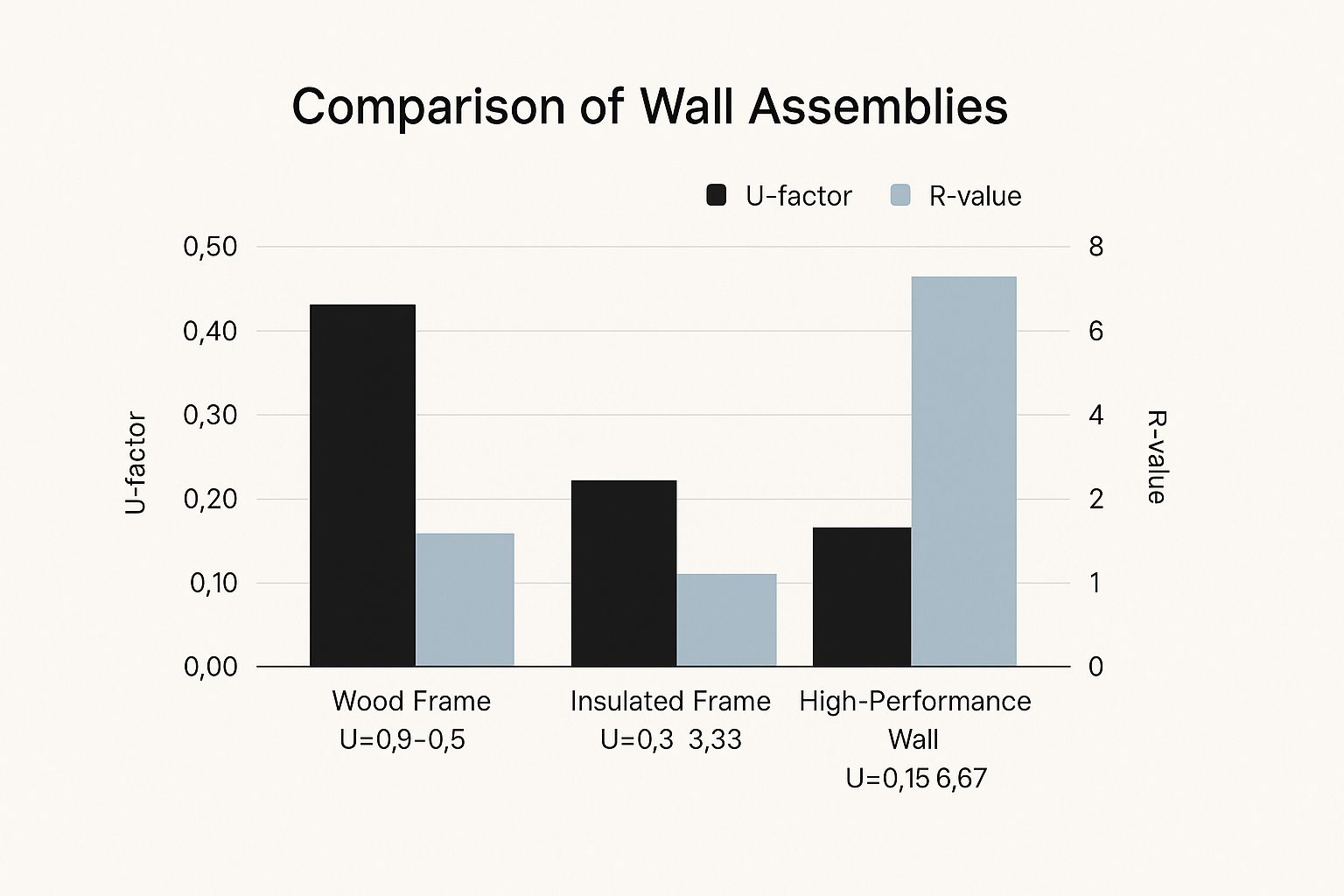
It’s clear from the graphic that the high-performance assembly has the lowest U-Factor and the highest R-Value, proving it has much better insulating power.
Why U-Factor Is the Key to Window Performance
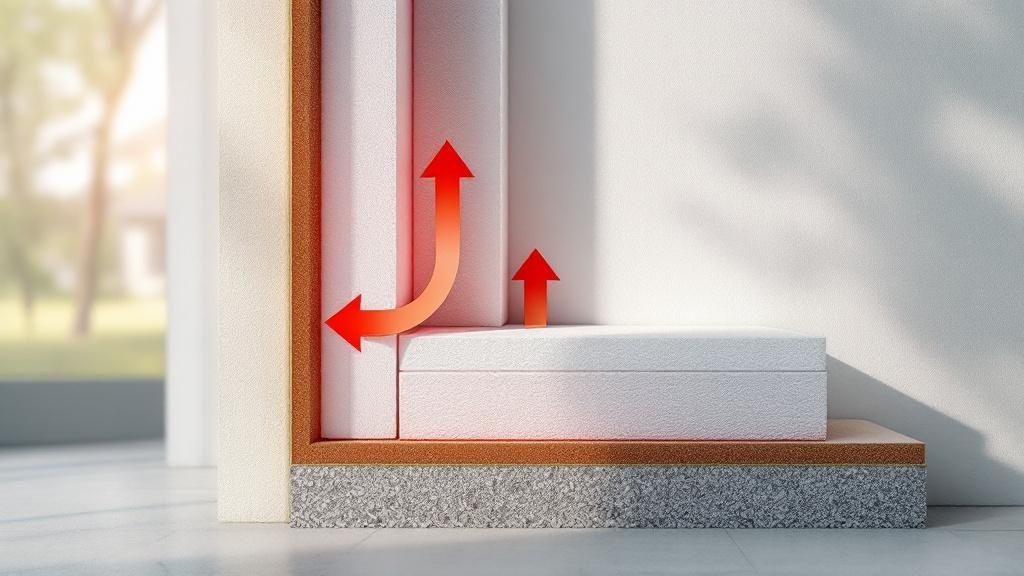
When you're looking at windows, the U-Factor is the single most important number to understand. Think of it like a golf score for your window's energy performance—the lower the number, the better it is at keeping your home comfortable.
This rating tells you how well a window prevents heat from escaping, which is a big deal on those chilly coastal mornings in Monterey and Carmel. A lower U-Factor means less heat is lost, which leads to lower heating bills and a cozier home.
Understanding the U-Factor Range
U-Factor ratings for windows typically run from a high of 1.20 down to a very efficient 0.20. Old, single-pane windows found in many historic Salinas homes often have a U-Factor of 1.0 or higher, making them a huge source of energy loss.
Modern high-performance windows, on the other hand, can achieve ratings below 0.30. The U-Factor is a complete measurement of the entire window, which includes:
- The Glass Panes: Whether the window is double-pane or triple-pane.
- The Frame Material: Vinyl, fiberglass, and wood frames have different insulating properties.
- The Spacers: These separate the glass panes and play a big role in efficiency.
- Gas Fills: Gases like argon are sealed between the panes to improve insulation.
Because it includes every component, the U-Factor gives you a true picture of how the window will perform in your home.
How Technology Has Pushed U-Factors Down
Window technology has made incredible leaps forward over the years. In the 1960s, a single-pane window with a U-Factor around 1.0 was standard. Today, modern double-pane windows can hit U-Factors around 0.25 to 0.3, an improvement of roughly 40% since the 1980s.
These gains come from breakthroughs like multi-pane glass, low-emissivity (Low-E) coatings, and insulating gas fills. They work together to reduce heat transfer, keeping your home warmer in winter and cooler in summer. For a deeper look, check out our guide on energy-efficient windows.
For homeowners in Monterey County, swapping out old single-pane windows for new, low U-Factor models is one of the smartest upgrades you can make. It will boost your home's comfort and cut energy costs all year long.
How R-Value Impacts Your Walls and Attic
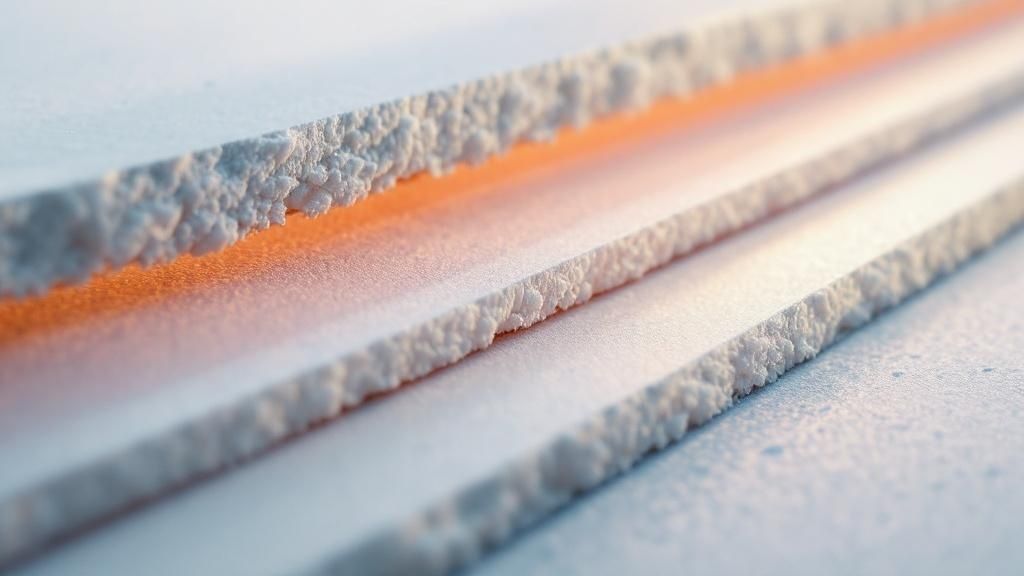
While U-Factor is crucial for your windows, R-Value is the star player for the rest of your home. It's the go-to measurement for insulation in your walls, attic, and floors. For homeowners in Salinas, thinking about R-Value is like picking a winter coat for your house—the higher the number, the warmer it will keep you.
A high R-Value means the material is great at resisting heat flow. It keeps your warm air inside during cool Monterey nights and blocks the sun’s heat on summer afternoons.
Why Walls and Attics Use R-Value
Unlike a complex window, wall and attic insulation is usually a single, uniform material like fiberglass or spray foam. Because of this, R-Value gives a clear and direct measurement of how well it resists heat.
The U.S. Department of Energy gives R-Value recommendations based on climate zones. Attics need high R-Values, since up to 25% of a home’s heat can escape through the roof.
A Simple Analogy: Think of R-Value like sunblock. An SPF 15 lotion gives you some resistance to UV rays, but SPF 50 provides much more protection. In the same way, R-38 insulation provides more resistance to heat flow than R-13 insulation.
A Whole-Home Approach to Energy Efficiency
Having well-insulated walls is a great start, but their effectiveness can be ruined by old, inefficient windows. Heat always finds the easiest path to escape. If your walls are R-13 but your windows have a high U-Factor (like an R-Value of R-1), that’s where your conditioned air will leak out.
For real energy efficiency, every part of your home needs to work together. Combining high R-Value insulation in your walls with low U-Factor windows creates a powerful system that keeps your home comfortable and your energy bills down. This strategy is one of the best ways you can learn how to save energy at home.
Insulation’s Role in Overall Comfort
Proper insulation does more than just save you money; it makes your home a much more comfortable place to live. It helps get rid of cold spots and drafts, creating a more even temperature from room to room.
Of course, insulation is just one piece of the puzzle. The type of heating system you have also plays a huge role in your home's comfort, as explained in a comprehensive guide to underfloor heating versus radiators. When you pair great insulation with an efficient heating system, you create a truly comfortable and cost-effective home.
Connecting U-Factor and R-Value
Now that we've covered U-Factor for windows and R-Value for walls, it's time to connect the dots. They might seem like different languages, but they both measure heat transfer.
The relationship is simple: they are mathematical inverses, meaning the formula is R-Value = 1 / U-Factor. But you don't need to get stuck on the math. The real takeaway for homeowners in Salinas is what this means in the real world.
A Simple Conversion Chart
To help you see this relationship, we've put together a simple conversion table. It shows how common window U-Factors translate into their approximate R-Value equivalents.
U-Factor to R-Value Conversion for Windows
| Common Window U-Factor | Equivalent R-Value (Approx.) | Performance Level |
|---|---|---|
| 1.00 | R-1 | Very Poor (Old Single-Pane) |
| 0.50 | R-2 | Poor (Older Double-Pane) |
| 0.33 | R-3 | Good (Standard New Construction) |
| 0.25 | R-4 | Excellent (High-Performance) |
| 0.20 | R-5 | Exceptional (Premium) |
As you can see, a lower U-Factor directly equals a higher R-Value. This means better insulation and more comfort for your family.
Putting Window Performance into Perspective
This is where things click for most homeowners. The walls in a typical modern home are insulated to at least R-13, with attics often reaching R-38 or higher. Now, look back at that chart. Even an excellent window with a U-Factor of 0.25 only equals an R-4.
This comparison highlights a critical point: windows are a thermal weak spot in your home’s envelope. Even the best windows have far less insulating power than a standard wall.
This is why choosing a window with the lowest possible U-Factor is one of the most important upgrades you can make. The jump from an old R-1 window to a modern R-4 window represents a 75% reduction in heat loss through the glass. This is especially important for homes in coastal areas like Carmel, where holding onto warmth is key for comfort and savings.
To get a sense of how these values impact your wallet, you can use tools like an energy consumption calculator to see their effect on your energy use. The window technology you choose, like double-pane versus triple-pane glass, directly influences these ratings. To learn more, dive into our comparison of double-pane vs. triple-pane windows.
Selecting Windows for the Monterey Bay Climate
Living here on the Central Coast gives us a unique mix of weather. We get cool, foggy mornings in Carmel and bright, sunny afternoons in Salinas—our homes need windows that can handle both.
For our climate, a low U-Factor is your best friend. It keeps the heat from your furnace inside during our chilly nights. A window with a good, low U-Factor acts as a solid barrier, preventing heat from slipping outside and lowering your heating costs.
Introducing Solar Heat Gain Coefficient (SHGC)
Next to the U-Factor on the window label, you'll see a rating called the Solar Heat Gain Coefficient (SHGC). This number tells you how well a window blocks the sun's heat from getting into your house.
SHGC is rated on a scale from 0 to 1, where a lower number means less solar heat gets through. While a very low SHGC is great for hot climates, our needs in the Monterey Bay area are a bit different.
Finding the Right Balance for Coastal California
For those of us in Salinas, Monterey, and Pacific Grove, the trick is to find a sweet spot between a low U-Factor and a moderate SHGC. This combination delivers the best year-round performance.
According to ENERGY STAR®, our region is in the South-Central climate zone. For this area, they recommend windows with:
- A U-Factor of 0.30 or less for excellent insulation.
- An SHGC of 0.25 or less to block unwanted heat gain in the summer.
Getting windows with these ratings means you’ll stay warm in the winter while also keeping your home from overheating on sunny days.
Local Insight: For a home in Carmel that’s often foggy, prioritizing the lowest U-Factor makes a lot of sense. But for a home in a sunnier part of Salinas, finding a window with a lower SHGC can make a big difference in summertime comfort.
Why NFRC Labels Are Your Best Tool
The National Fenestration Rating Council (NFRC) label is your key to making a smart decision. This sticker gives you independently tested ratings for U-Factor and SHGC. It removes the guesswork and helps you choose a window that’s truly built for our local climate.
By understanding the label, you can confidently pick windows that will improve your home's comfort and efficiency. It’s about looking beyond the simple "u factor vs r value" debate to make the best investment for your home.
Why Expert Installation Unlocks True Performance

You can pick the perfect window with a fantastic U-Factor, but without proper installation, those energy-saving benefits can disappear. The quality of the installation is just as critical as the quality of the window itself.
If a window isn't installed correctly, it can't perform as designed. Tiny gaps or a bad seal can create air leaks, leading to drafts and wasted energy. A poor installation can cancel out the low U-Factor you carefully chose and paid for.
The Dangers of Improper Installation
A professional installation is a precise process that avoids common problems. Key issues that can ruin your window's performance include:
- Air Leaks: Small gaps around the window frame can let cold air into your Salinas home, creating drafts and forcing your heater to work overtime.
- Poor Seals: If the seal between the window and your home fails, moisture can get in, leading to water damage, rot, and mold.
- Incorrect Flashing: Flashing directs water away from the window. If installed wrong, it can trap moisture inside your walls and cause serious damage.
These problems show that the numbers on a label and how a window actually performs in your home can be two different things.
Why Local Expertise Matters for Monterey County Homes
This is why trusting a local, experienced team is the best way to protect your investment. Professionals who work in Monterey County know the challenges of our coastal climate and the construction styles of homes in places like Carmel and Pacific Grove.
An expert installer ensures that the U-Factor on the label is the U-Factor your home actually gets. They use proven techniques to create an airtight seal that maximizes your window's efficiency for years to come.
Understanding the cost of energy-efficient windows means factoring in the value of professional installation. Much like hiring qualified air conditioning contractors, choosing a certified team ensures your new windows deliver the comfort and savings you expect.
Frequently Asked Questions About U-Factor and R-Value
We've put together some clear answers to the questions we hear most from residents right here in Salinas and Monterey. Our goal is to help you feel completely confident as you plan your window replacement project.
What is a good U-Factor for windows in California?
For homeowners in the Monterey Bay area, ENERGY STAR® recommends a U-Factor of 0.30 or less. This ensures your windows do an excellent job of keeping heat inside your home. For even better performance, look for windows with a U-Factor below 0.25 to maximize your energy savings and comfort.
Can I convert R-Value to U-Factor when comparing windows?
While you can technically use the formula U = 1/R, it's not an accurate way to compare windows. R-Value only measures heat resistance in a single spot, while a window's certified U-Factor is a complete rating that accounts for the glass, frame, spacers, and any insulating gases. Always rely on the NFRC-certified U-Factor for a true comparison.
Does a window's U-Factor change over time?
A high-quality, professionally installed window should maintain its rated U-Factor for decades. The components that create a low U-Factor, like Low-E coatings and gas fills, are sealed within the glass unit. A broken seal can allow the gas to leak, which would increase the U-Factor, which is why professional installation is so important.
Why isn't R-Value used for windows if it's used for walls?
Windows do more than just block heat; they also manage sunlight (Solar Heat Gain) and visible light. R-Value doesn't measure these factors. The NFRC rating system, which includes U-Factor and SHGC, gives you a much more complete picture of a window's performance. U-Factor is the best metric for a complex system like a window.
What is more important, U-Factor or SHGC?
For our coastal climate, both are important, but they do different jobs. U-Factor is critical for keeping your home warm during our cool, foggy mornings and chilly nights. SHGC is important for blocking the sun's heat on warm, sunny afternoons. The best approach is to find a window that meets the ENERGY STAR® recommendations for both: a U-Factor of 0.30 or less and an SHGC of 0.25 or less.
Ready to upgrade to windows perfect for the Central Coast climate? The experts at Signature Glass and Windows, Inc., a locally owned and family-operated business, have been helping homeowners in Salinas, Monterey, and Carmel for decades. Contact us today at 831-754-8855 for a free, no-obligation consultation.